26 Spring Nail Designs I’d Actually Wear (and the One Trend I’m Skipping)
My spring nail routine used to be a disaster.
Every March I’d walk into the salon with a blurry screenshot and walk out with something that looked nothing like it—usually because I’d asked for “pastel” and gotten something closer to Easter egg dye.
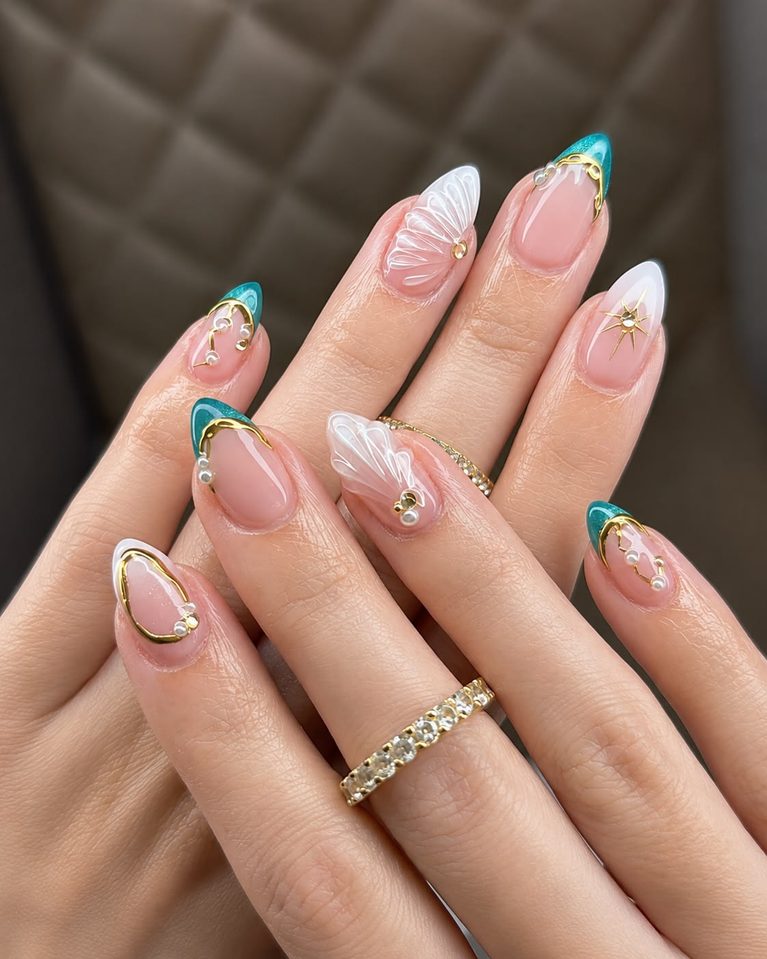
The breaking point was two springs ago, when I asked for a “soft lavender” and ended up with a lavender so saturated it glowed under office fluorescents.
I spent the next ten days hiding my hands under my sleeves. What I learned the hard way is that spring nail designs are not just about the color.
They’re about finish, shape, and how much visual noise you can tolerate on your own hands for two weeks straight.
This season is actually a good one for people like me. The dominant direction for spring 2026 is “elevated simplicity”—softer chromes, milky washes, and tiny details instead of loud graphics.
That means there are more wearable options than usual, and fewer designs that only look good in a ring light.
Below are 26 spring nail designs I’ve either worn, tested on a friend, or watched a nail tech pull off while I took mental notes. Some are five-minute polish jobs.
A few cost real money. And one trend I’m genuinely skipping, with a reason.
Soft Chrome and Glazed Finishes: The Spring 2026 Upgrade
1. Soft Chrome Over a Milky Base
The full-mirror chrome of the last few years is taking a back seat this spring. What’s replacing it is softer and more diffused—a fine chrome powder buffed lightly over a sheer or milky base, so it catches the light without looking like a tiny disco ball. Celebrity manicurist Kim Truong describes it as a natural evolution of the quiet-luxury aesthetic: “Clients still want something elevated and reflective, but not overly bold or metallic”. I tried this with a milky nude base and a pearl chrome powder, and it was the first chrome set that didn’t feel like a commitment.
How to do it: Start with a sheer or milky gel base. Seal with a no-wipe top coat, buff in a fine chrome powder, then finish with another top coat. The key is a soft, diffused chrome rather than a high-impact metallic.
Pro tip: Chrome powder does not work over regular polish. If you don’t have a gel lamp, a chrome-effect polish gives you a similar vibe without the setup—it just won’t have the same mirror finish.
2. Milky Pearl
Milky white is one of the defining colors of 2026, largely because Pantone named Cloud Dancer its color of the year. On its own, milky white can read a little flat. With an iridescent chrome overlay, it becomes something else—clean but not boring, reflective but not loud. I’ve seen this on a reader’s Instagram and copied it the same week.
Trade-off: Milky bases show ridges. If your nails aren’t smooth, use a ridge-filling base coat before the chrome. Sheer finishes amplify texture instead of hiding it.
Pro tip: A pearl chrome over milky white looks warmer on olive skin than a silver chrome. If you’re between the two, swatch both on a bare nail first.
3. Jelly Chrome
Jelly chrome sits somewhere between a glaze and a chrome—a sheer, candy-like color with a reflective top layer that makes the nail look like stained glass. It’s playful without being childish, and it works on short nails because the sheer finish doesn’t need length to look intentional. This is one of the designs that has been showing up consistently in spring trend reports, and it’s easy to see why.
How to do it: A sheer jelly polish in a candy color (peach, mint, lilac), then a chrome-effect top coat or a light buff of chrome powder. If you’re using regular polish, a pearlescent top coat gets you close.
Pro tip: Jelly chrome looks best in two thin layers of color, not one thick one. The sheerer the base, the more the chrome has to reflect against.
4. Lavender Aura with Chrome Edge
Aura nails—the diffused, airbrushed gradient that looks like a soft glow in the center of the nail—are still going strong this spring, but the color palette has shifted. Instead of icy lavenders, the current version leans toward misty blues and soft greens. A lavender aura with a thin chrome line at the edge is the version I’d actually wear: the chrome gives the soft blur a clean border, so it doesn’t look like a bruise.
Trade-off: Aura designs are airbrush-heavy. If you’re doing them at home with a sponge, the edges will be less crisp than a salon version. That’s fine—the whole point is softness.
Pro tip: Use a matte top coat on the aura and a glossy top coat only on the chrome edge. The texture contrast makes the design look more deliberate.
Milky, Sheer, and “Your Nails But Better” Designs
5. Milky Lavender
Milky finishes are everywhere this spring, and lavender is one of the shades leading the charge. The appeal is that it doesn’t look like polish—it looks like your nails, only slightly better. On short square nails, a cool-toned milky lavender reads clean and modern; on long almonds, it can go a little ghostly. I keep this one for weeks when I want something on my nails but I’m not in the mood to think about them.
How to do it: Two coats of a milky lavender, no top coat if you want the true “milk” finish. A glossy top coat makes it read more like traditional polish.
Pro tip: Milky shades pool at the cuticle if you overload the brush. Wipe one side of the brush completely before the first stroke.
6. Blueberry Milk
Blueberry milk is the cool, slightly gray-leaning periwinkle that sits between baby blue and lavender. It’s the kind of spring nail design that looks like you just happen to have nice nails, not like you spent an hour on them. I wore a blueberry milk set for a week in April and got three separate “where did you get that” texts—which, for a sheer color, is unusual.
Trade-off: Blueberry milk is a three-coat color on most nails. Do not try to make it work in two; you’ll get patchiness at the cuticle line.
Pro tip: Blueberry milk looks especially good with a matte top coat. The lack of shine makes the gray-blue undertone more visible.
7. Sheer Peach Wash
Sheer peach is having a quiet moment as the warmer, more skin-adjacent alternative to pink and lavender. It’s not a statement color, but it makes hands look healthy and awake, which is more than I can say for some of the more saturated pastels I’ve tried. On medium and deep skin, a sheer peach with a hint of shimmer reads warmer than a flat nude.
How to do it: One or two coats of a sheer peach, depending on how much coverage you want. If the polish is very sheer, layer it over a ridge-filling base.
Pro tip: Sheer peach and sheer pink are not interchangeable. Peach has a yellow undertone that suits warm and olive skin; pink has a cooler undertone that can pull ashy on the same hands.
8. Foam White
Pantone’s Cloud Dancer—a soft, grayish-white—has made white nails a legitimate spring choice rather than a summer vacation cliché. Foam white is slightly warmer and more wearable than a stark optic white, and on short squoval nails it reads like a clean slate. I’ve been using it as a base for micro-French designs more than wearing it alone.
Trade-off: White polish shows every flaw in application. Streaks, bubbles, and cuticle flooding are all more visible in white than in any other color.
Pro tip: Apply white in three very thin coats, not two thick ones. Thin coats level better and dry faster, which reduces streaking.
Pastel French Tips and Micro-French Designs
9. Mint Micro-French
“Millennial mint” is the pastel shade that’s been exploding on TikTok this spring, and for good reason: it acts as a visual reset in a way that peach and lavender don’t. A micro-French tip in mint over a milky nude base is the most wearable version—the line is so thin it reads like a shadow, which means it works on short nails without making them look stubby. I did this with a striping brush and a lot of patience.
How to do it: A sheer nude or milky base, then a mint tip no thicker than a credit card edge. If the line is visible from across the room, it’s too thick.
Pro tip: Mint French tips look best on short, rounded or squoval nails. On long almonds, the thin line gets lost.
10. Butter Yellow French with Daisy Accent
Butter yellow is one of the biggest color stories of spring 2026—it’s soft, warm, and less aggressive than lemon yellow. A butter-yellow French tip with a single hand-painted daisy on the ring finger is the kind of spring nail design that looks like it took an hour and actually took twenty minutes. OPI’s Sunny Bunny and Essie’s Sunny Business are the two shades I’ve seen used most for this.
Trade-off: Yellow polish is notoriously streaky. Butter yellow is more forgiving than a bright yellow, but it still needs three thin coats.
Pro tip: Paint the daisy with a dotting tool and a liner brush, not the polish brush. A single drop of white polish dragged outward makes a petal in one stroke.
11. Pastel Tips with a Milky Base
Instead of one pastel French tip, this design uses a different pastel on each nail—mint, butter yellow, baby blue, milky pink—all over the same sheer nude base. It sounds chaotic, but because the tips are thin and the base is uniform, the effect is playful rather than messy. I’ve only done this once, and I’d do it again for a trip where I wanted my nails to be a small, private joke.
How to do it: Paint the base first on all ten nails and let it dry completely. Then do the tips one hand at a time.
Pro tip: Keep the tip thickness consistent across all five colors. A thick mint tip next to a thin blue tip will look like a mistake, not a design.
12. Navy and Light Blue Striped French
Striped manicures have been rising steadily since the start of 2026, and the short-nail version is one of the most versatile iterations. A navy and light blue striped French tip on short, rounded nails reads preppy or cool depending on what you’re wearing, which makes it unusually practical for a design this specific.
Trade-off: Stripes demand a steady hand. If the lines wobble, the whole design reads as messy. A striping brush and a resting pinky are non-negotiable.
Pro tip: Paint the lighter stripe first, let it dry, then add the darker stripe on top. Dark over light is easier to correct than light over dark.
Floral and Botanical Designs (Without the Craft-Project Energy)
13. Micro Daisies on a Milky Nude
Floral nails can go twee fast. The version that doesn’t is micro daisies—tiny white petals with a yellow center, scattered on a milky nude base rather than a solid color. It’s the design I recommend to people who say they “hate floral nails,” because it reads as texture rather than a flower.
How to do it: A dotting tool for the petals and a smaller dotting tool or toothpick for the center. Three or four daisies per hand is plenty; more than that and it starts to look like a pattern.
Pro tip: Place the daisies off-center rather than in a neat row. A slightly scattered placement looks hand-painted; a grid looks stamped.
14. Cherry Blossom Tips
Cherry blossom nails are a perennial spring favorite, but the 2026 version is softer and more sheer than the opaque pink blossoms of previous years. A sheer base with tiny pink and white blossoms clustered near the tip—almost like the French tip is blooming—is the version I’ve seen done well.
Trade-off: Cherry blossoms are detail-heavy. On short nails, the petals get compressed and can read as smudges. Medium-to-long nails give the design room to breathe.
Pro tip: Use a sheer pink jelly as the base and paint the blossoms with a slightly more opaque white-pink. The contrast needs to be subtle; high-contrast blossoms look like stickers.
15. Watercolor Wildflowers
Watercolor florals are the looser, more abstract cousin of micro daisies. Instead of defined petals, you get washes of color—soft blues, greens, and pinks—that bleed into each other like a real watercolor painting. It’s a design that hides mistakes well, which makes it a good candidate for DIY.
How to do it: Drop two or three sheer colors onto the nail while the base is still wet, then drag them together with a liner brush. Don’t overwork it—three passes is usually one too many.
Pro tip: Watercolor designs look best over a milky or nude base, not a bare nail. The base gives the colors something to sit against.
16. Green French Tips with White Florals
Green French tips are a small but real sub-trend this spring, and pairing them with tiny white florals near the cuticle turns a simple tip into something more interesting. The green should be soft—sage or matcha rather than emerald—and the florals should be small enough to read as an accent, not a feature.
Trade-off: Green is a polarizing color on nails. If you’re not sure, swatch it on one nail before committing to a full set. Sage is more forgiving than matcha.
Pro tip: Paint the French tip first, then add the florals. It’s easier to place small details on a finished tip than to work around wet polish.
Geometric, Striped, and Patterned Designs
17. Neo Deco Chevrons
Pinterest Predicts 2026 named “Neo Deco” as a style to watch—crisp chevrons, fan arches, and other geometric hits with a retro feel. On nails, the most wearable version is a single chevron or fan arch on an accent nail, not a full set of geometry. I’ve seen it done in cobalt and cream, and it looked like a tiny piece of graphic design on each finger.
How to do it: Use striping tape or a very steady hand with a liner brush. The lines need to be crisp; a wobbly chevron looks like a mistake, not a design.
Pro tip: Matte top coat makes geometric designs look sharper and more intentional. Glossy top coat softens the edges and makes the lines look less precise.
18. Simple Line Art
Line art has been quietly climbing since the start of 2026—thin, minimal lines in black, white, or a single color, placed vertically, diagonally, or along the French curve. It’s the design I wear when I want something on my nails but I’m going into a week of typing and dishwashing. One line on each nail is enough.
Trade-off: A single wobbly line is more noticeable than a busy design because there’s nothing to distract from it. If your hands aren’t steady, a nail-art sticker is undetectable at arm’s length.
Pro tip: Rest your pinky on the table and draw the line in one continuous motion, not a series of short strokes.
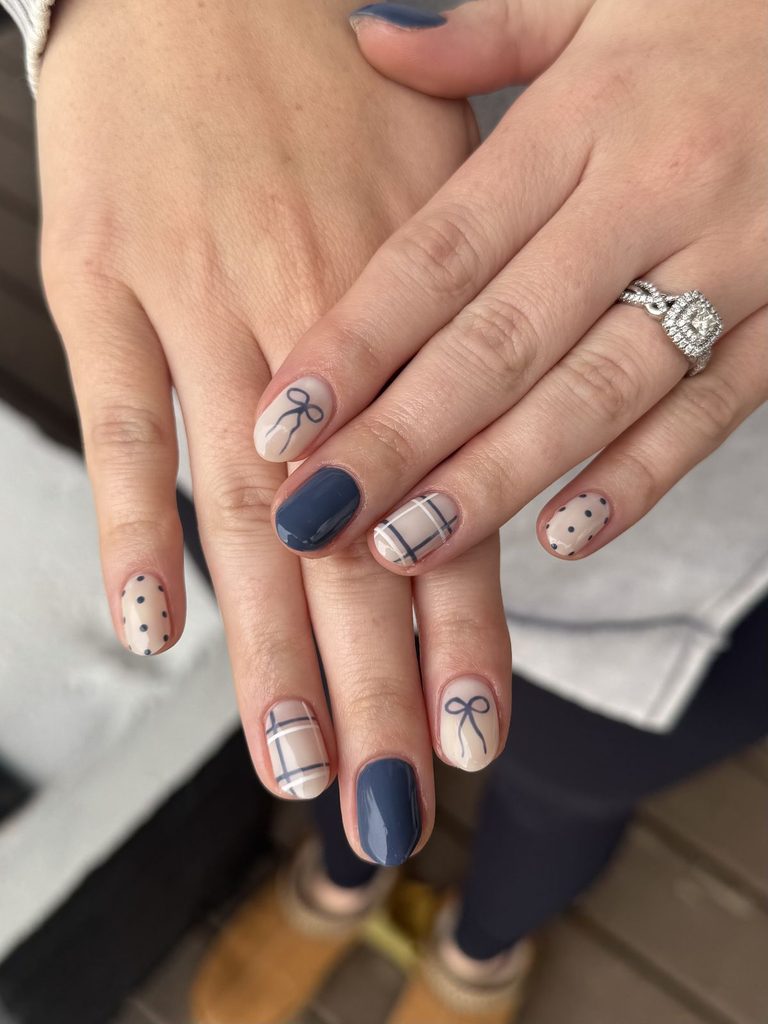
19. Polka Dot French Tips
Polka dots are having a resurgence—searches are up significantly year-on-year, and the 2026 version is more graphic and less cutesy than the dots of previous seasons. Polka dot French tips, where the dots replace the traditional solid tip, are the iteration I’d actually wear. A mix of dot sizes adds depth without making the design look busy.
How to do it: Use two dotting tools—one large, one small—and place the dots along the French curve rather than in a straight line.
Pro tip: Black dots on a nude base read graphic; white dots on a pastel base read soft. Choose based on whether you want the design to feel sharp or gentle.
20. Checkerboard Accent
Checkerboard prints are back in the zeitgeist, but a full checkerboard set is a lot. A single checkerboard accent nail—black and white, or two shades of the same color—paired with solid nails is the wearable version. I’ve done this with a navy and light blue checkerboard on the ring finger, and it was the most complimented DIY manicure I’ve ever done.
Trade-off: Checkerboard requires precision. If the squares are uneven, the whole design looks off. A stamping plate is faster and more accurate than freehand.
Pro tip: Paint the base color, let it dry completely, then use striping tape to block off the squares before painting the second color.
Short Nail Designs That Don’t Feel Like a Compromise
21. Short Almond with a Single Chrome Accent
Short nails are officially back in rotation this spring, and the key shape is somewhere between oval and square—soft, rounded, and practical. A single chrome accent nail on an otherwise solid short almond set gives the design a focal point without requiring length. I keep coming back to this because it’s the easiest way to make short nails look intentional.
How to do it: Solid color on four nails, chrome powder or chrome-effect polish on the ring finger. If you’re using regular polish, a chrome top coat gets you close.
Pro tip: On short nails, keep the chrome accent on the ring finger or middle finger. The index finger draws more attention, and a chrome accent there can look unbalanced.
22. Short Squoval with a Micro-French in Cobalt
Cobalt is one of the two colors dominating French manicures this spring, and on short squoval nails it reads graphic and modern without tipping into “I’m going to a festival” territory. The micro-French keeps the color from overwhelming the short nail; a thick cobalt tip on a short nail can look like a bruise.
Trade-off: Cobalt stains. A base coat is not optional, and even with one, expect a slight yellow tint after removal.
Pro tip: A wider flat brush gives you fewer streaks in one pass. Cobalt shows every brush stroke.
23. Short Round with a Peach Wash and Micro-Glitter
A sheer peach wash with a single coat of micro-glitter is the short-nail design I recommend to people who want something “done” but not “designed.” It’s clean, it catches the light, and it doesn’t require any precision. I wore this for a week of travel and it held up better than most of my gel sets.
How to do it: One coat of sheer peach, one coat of micro-glitter, one top coat. That’s it.
Pro tip: Micro-glitter looks best when it’s sparse. If the glitter is dense, the peach wash disappears underneath it.
The One Trend I’m Skipping (and Why)
24. Full 3D Charms and Baubles
3D nail art is still around, but 2026 is seeing a step back from the full-jewelry-box look—designers and manicurists are scaling down to “bite-sized” textured details rather than full constellations of charms. I’m skipping the full 3D set because I type too much and I hate the feeling of something catching on my keyboard. If you love it, the current version is more restrained than the maximalist sets of previous years, which makes it more wearable than it used to be. But it’s still the least practical option on this list.
Trade-off: 3D art chips, catches, and is hard to fix at home. If you want the look without the maintenance, a chunky glitter or a single large flake gives you texture without the snag.
Pro tip: If you do go 3D, keep the charms to one or two per hand and place them near the cuticle rather than the tip. Tip placement catches on everything.
A Few More Spring Designs Worth Knowing
25. Fawn Print Accent
Fawn print—yes, deer print—is one of the more unexpected trends this spring, and Pinterest’s 2026 predictions have given it momentum. A single fawn-print accent nail on a set of solid nudes or browns is the version that makes sense for adults; a full fawn-print set reads costume. I’ve only seen this done well once, and it was on a friend who works in fashion and can pull off things I cannot.
Trade-off: Animal prints are polarizing. If you’re not sure, do one accent nail and live with it for a week before committing.
Pro tip: Fawn print works best in a warm brown palette. Cool-toned browns make the print look muddy.
26. Strawberry Mochi Pink
Mochi pink is being called the color of the moment for spring 2026—a soft, creamy, slightly translucent pink that sits between ballet slipper and strawberry milk. On short rounded nails, it reads clean and slightly sweet without being childish. OPI’s I’m a Bubble Bunny, a combination of Bubble Bath and Funny Bunny, is the shade I’ve seen used most for this effect.
How to do it: Two coats of a sheer, creamy pink. If you want more opacity, layer it over a milky base.
Pro tip: Mochi pink pairs unusually well with a single matcha-green accent nail. The contrast is softer than pink-and-white and more interesting than pink-and-nude.
Spring Nail Designs Comparison: What Works for Your Nail Length, Skin Tone, and Patience Level
The right spring nail design is less about what’s trending and more about what will still look good on your hands in seven days. Use this table as a starting point, not a rulebook—swatch on your own nail before committing to a full set.
| Design family | Best nail length/shape | Skin tone notes | DIY difficulty | Wear time (gel) |
|---|---|---|---|---|
| Soft chrome / milky pearl | Short to medium almond or squoval | Milky bases flatter fair and medium skin; pearl chrome warms on olive | Moderate (needs gel for true chrome) | 10–14 days |
| Milky / sheer washes (lavender, blueberry, peach) | Short almond or square | Sheer peach suits warm/olive; lavender suits cool tones | Easy | 7–10 days |
| Micro-French (mint, butter, pastel) | Short rounded or squoval | Mint flatters most; butter yellow warms fair and medium skin | Moderate (needs a steady hand) | 10–14 days |
| Floral (micro daisies, cherry blossom, watercolor) | Medium almond or oval | Sheer bases work across tones; avoid opaque pastel bases on deep skin | Hard to moderate | 10–14 days |
| Geometric / line art / stripes | Short to medium squoval | High-contrast lines work on all tones; pastel lines can wash out fair skin | Moderate | 10–14 days |
| Cobalt / bold French | Short squoval | High contrast flatters deep and fair skin | Moderate | 10–14 days |
| 3D charms | Medium to long almond | N/A (design-dependent) | Salon recommended | 7–10 days (fragile) |
How Much Do Spring Nail Designs Actually Cost?
I’m not going to pretend a chrome set is a drugstore purchase. Here’s the real breakdown, based on what I’ve paid and what I’ve seen friends pay in mid-size U.S. cities.
| Format | Typical cost | Time | Wear time | Best for |
|---|---|---|---|---|
| Drugstore polish + DIY | $8–$15 per bottle | 30–45 min | 4–7 days | Milky washes, simple micro-French, line art |
| Gel polish + DIY lamp | $40–$80 startup, then $10–$15 per bottle | 45–60 min | 10–14 days | Soft chrome, jelly chrome, cobalt French |
| Salon gel manicure | $45–$70 | 45–60 min | 14–21 days | Floral, geometric, aura, chrome |
| Salon art / chrome set | $60–$100+ | 60–90 min | 14–21 days | 3D charms, watercolor, detailed florals |
The honest answer: if you’re going to fall in love with soft chrome or detailed florals, budget for the salon. If you’re testing the waters, a $10 bottle of milky lavender and a $6 base coat will tell you more than any trend report.
Frequently Asked Questions About Spring Nail Designs
What are the biggest spring nail trends for 2026?
The dominant direction is “elevated simplicity”—soft chrome finishes, milky and sheer washes of color, micro-French tips, and tiny details instead of loud graphics. Soft chrome, mochi pink, milky lavender, and pastel micro-French designs are the most consistent trends across reports. Short nails are also back in rotation, with a soft oval-to-square shape replacing long almonds.
What nail shape is best for spring 2026?
Short to medium, with a shape somewhere between oval and square—often called squoval or soft round. Longer almond and coffin shapes still work for floral and geometric designs, but the dominant direction is shorter and more practical.
Are pastel nails still in style for spring?
Yes, but they’ve changed. The current version is more muted and translucent than the sugary pastels of previous seasons—think milky lavender instead of bright lilac, butter yellow instead of lemon, and sage instead of mint green.
What is “soft chrome” and how is it different from regular chrome?
Soft chrome uses a finer, more diffused chrome powder over a sheer or milky base, so the finish is reflective but not mirror-like. It’s meant to enhance the base color rather than overpower it, which makes it more wearable for everyday than a high-impact metallic chrome.
Do I need gel to do chrome nails at home?
For a true chrome finish, yes—chrome powder needs a tacky gel surface to adhere to. A chrome-effect polish or a pearlescent top coat is a simpler at-home alternative, but it won’t give you the same mirror or soft-chrome finish.
What spring nail designs work on short nails?
Milky washes, micro-French tips, simple line art, soft chrome, and single accent nails all work well on short nails. Avoid designs that need vertical space—watercolor florals and full checkerboard sets look compressed on very short nails.
How do I keep sheer or milky polish from looking streaky?
Thin coats, not thick ones. Sheer and milky formulas pool and streak when you overload the brush. Wipe one side of the brush completely before the first stroke, and use a ridge-filling base coat if your nails have texture.
What I’d Do First If I Were Starting Over
If I could go back to that glowing-lavender disaster, I’d start with a milky base and a micro-French tip—something soft enough to live with for a week before I committed to chrome or florals. The spring nail designs on this list that actually hold up are the ones where the finish and the shape agree with each other: soft chrome on short almonds, milky washes on square nails, micro-French tips on rounded tips. Spring is the season for a visual reset, and your nails don’t need to be the loudest thing in the room to be the most intentional. Start with one design you can do with a bottle you already own, and let the rest of the list wait until you’re ready for the salon.